
Hi, I have a question about the answer of this question. I think for the last example since it's grammatically wrong and should have used 'was' instead of 'is' the correct answer should be 'lexical' rather than syntactic.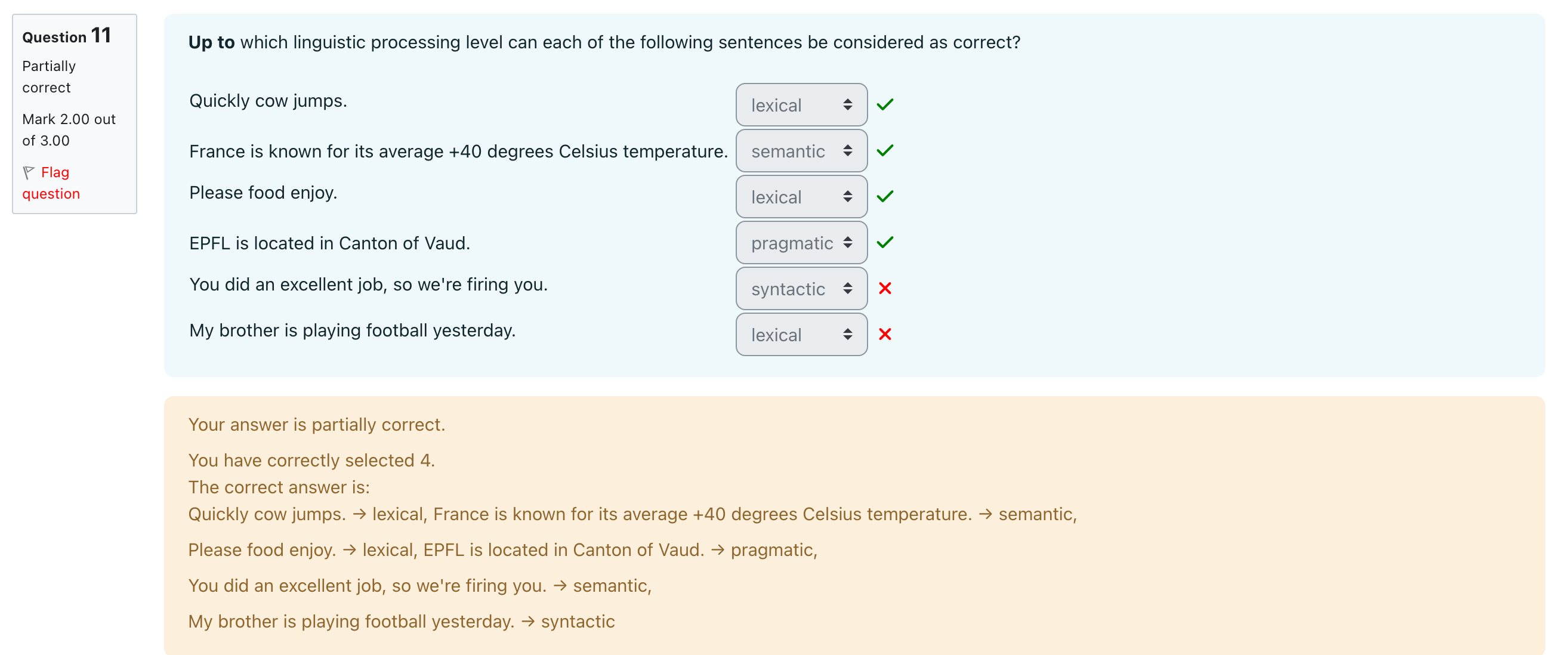
Also for the following question I believe that in this case of this example since there is no priority or weight for predicting positive classes in compare to negative classes the only metric that could be solely considered is f1-score. This is because lets say we have a system with precision=1 and recall=0 then its almost useless in this setting. I believe the answer is only f1-score because we need a fair tradeoff between precision and recall and neither of precision or recall could be used as a sole metric for the evaluation. Lets say if we have a system for detecting cancer among patients then there recall is more important and the answer could be f1-score and recall but for this example with my reasoning I expected the answer to be only f1-score.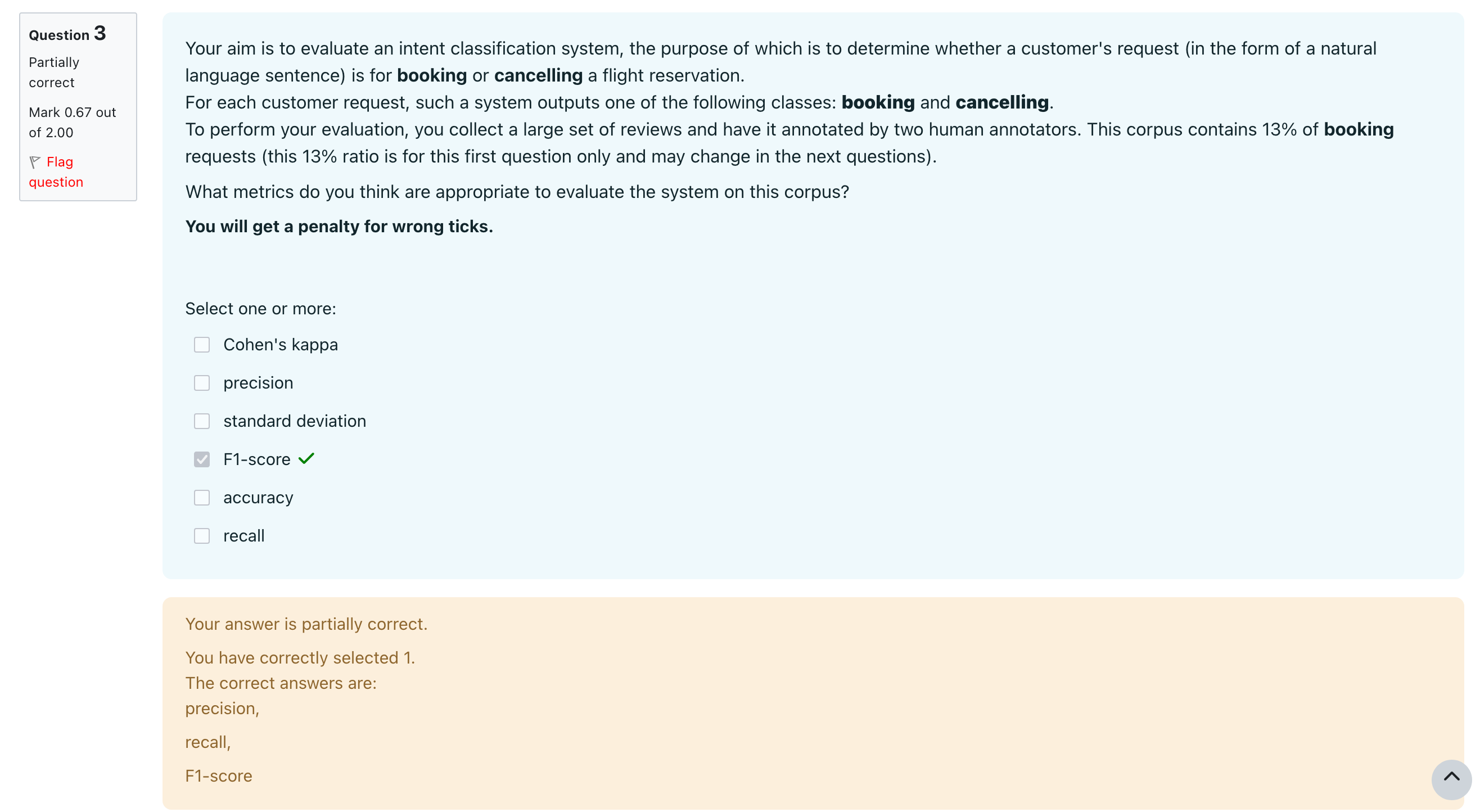
I would appreciate it if you could correct me if I'm wrong so at least I can learn from my mistake for the exam :)
Hello again!
For the first one: what about "My brother is playing football now."?
Is the difference between "now" and "yesterday" syntactic or semantic?
For the second question: What is F1-score?
Thus whenever you can use F1-score you could also use precision and recall (having the two provides you with even more information than just the F1).
Best,
For the first one: what about "My brother is playing football now."?
Is the difference between "now" and "yesterday" syntactic or semantic?
For the second question: What is F1-score?
Thus whenever you can use F1-score you could also use precision and recall (having the two provides you with even more information than just the F1).
Best,
Hi again :)
I believe the sentence “My brother is playing football now” is syntactically correct because of the word “now.” The example I had in the exam contained a grammatical issue it used “yesterday” together with the present tense. As far as I know, grammatical errors can be considered a type of syntactic error.
Regarding the second question, I think I didn’t explain my answer clearly enough. What I meant is that precision and recall are not metrics we can rely on individually without considering one in relation to the other which is why I believe the F1-score is the best answer. Although the F1-score is derived from precision and recall, these two metrics alone (for example only recall or only precision) aren’t sufficient, especially in this question, since both classes of predictions are equally important to us.
Best regards
I believe the sentence “My brother is playing football now” is syntactically correct because of the word “now.” The example I had in the exam contained a grammatical issue it used “yesterday” together with the present tense. As far as I know, grammatical errors can be considered a type of syntactic error.
Regarding the second question, I think I didn’t explain my answer clearly enough. What I meant is that precision and recall are not metrics we can rely on individually without considering one in relation to the other which is why I believe the F1-score is the best answer. Although the F1-score is derived from precision and recall, these two metrics alone (for example only recall or only precision) aren’t sufficient, especially in this question, since both classes of predictions are equally important to us.
Best regards
For the first point, you didn't answer my question: Is the difference between "now" and "yesterday" syntactic or semantic?
For the second, you missed my point: we didn't ask for the best metric (which can be debated) but for all possible metrics in such a case.
Best,
For the second, you missed my point: we didn't ask for the best metric (which can be debated) but for all possible metrics in such a case.
Best,
Hi,
For the first question, I believe I may have partly addressed your point, but I now see where the confusion lies. The difference between “now” and “yesterday” can indeed be viewed as semantic, since the issue comes from the mismatch in meaning between the time adverb (yesterday) and the verb tense (is playing). However I believe one could argue that the verb form itself makes the sentence grammatically incorrect and hence this sentence has syntactic issues. If we consider that the issue of this sentence lies in the verb tense ('is' to 'was') then the answer is different with when we assume the error lies in the adverb.
For the second question, I didn’t mean to suggest that the F1-score is the best metric, but rather that precision and recall, when taken individually, don’t provide a complete picture of the system’s performance. My point was that the F1-score is useful precisely because it combines both precision and recall and precision and recall are not indicative by themselves and that's why we need f1-score specially in this task where classes have the same importance.
I appreciate your help!
Best regards,
For the first question, I believe I may have partly addressed your point, but I now see where the confusion lies. The difference between “now” and “yesterday” can indeed be viewed as semantic, since the issue comes from the mismatch in meaning between the time adverb (yesterday) and the verb tense (is playing). However I believe one could argue that the verb form itself makes the sentence grammatically incorrect and hence this sentence has syntactic issues. If we consider that the issue of this sentence lies in the verb tense ('is' to 'was') then the answer is different with when we assume the error lies in the adverb.
For the second question, I didn’t mean to suggest that the F1-score is the best metric, but rather that precision and recall, when taken individually, don’t provide a complete picture of the system’s performance. My point was that the F1-score is useful precisely because it combines both precision and recall and precision and recall are not indicative by themselves and that's why we need f1-score specially in this task where classes have the same importance.
I appreciate your help!
Best regards,